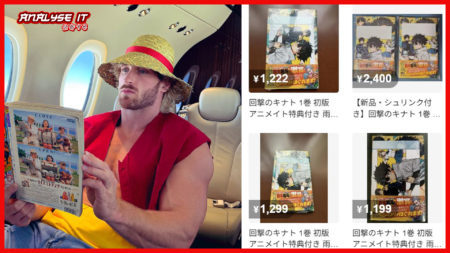
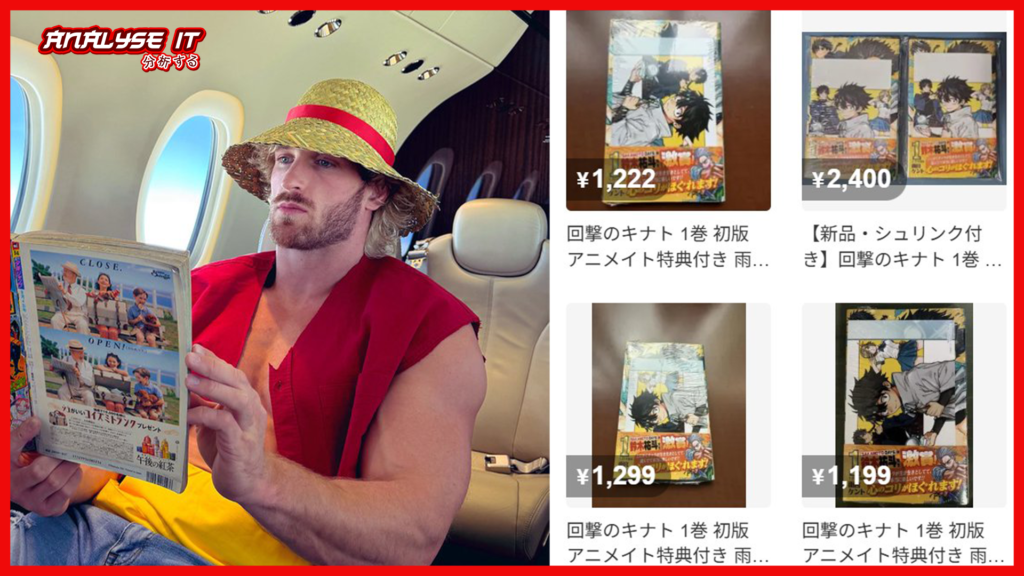
Jump Comics released numerous volumes this June, including the debut editions of the new series Under Doctor and Kinato’s Magic. However, within a few days, the vast majority of these copies sold out in both online and physical stores, subsequently being traded on resale platforms at abusive and inaccessible prices. Outraged, the Japanese public has begun to blame scalpers for market manipulation.
However, this problem did not start this June, but rather two months ago, when an internet celebrity used his influence to trigger a movement that has been harming various sectors of the manga market. Understand the case:
WHAT LOGAN PAUL DID
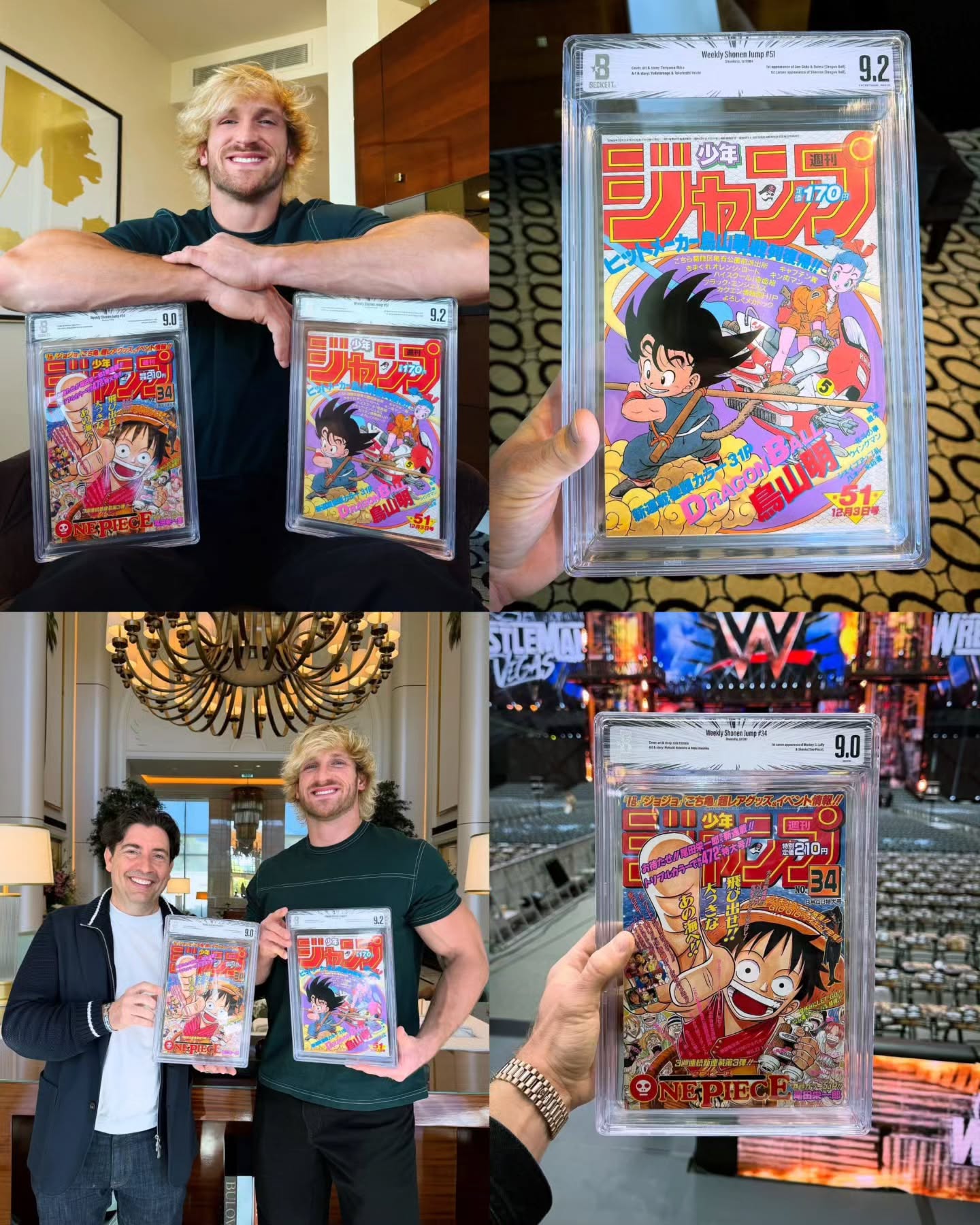
On April 21, American celebrity Logan Paul (23 million followers on YouTube) posted news on his Instagram that would shake the manga collecting market. The YouTuber revealed that he had acquired, for hundreds of thousands of dollars, the issues of Weekly Shonen Jump featuring the debuts of Dragon Ball and One Piece. Along with this announcement, he promoted his own online collecting platform, RIPIT, which aims to establish a marketplace for buying and selling rare items.
Logan Paul, who theoretically has never read the One Piece manga, posted on his Instagram:
“Proud owner of the biggest mangas in the world. One Piece Chapter One 9.0 (second highest grade in the world, pop 3) purchased for $XXX,XXX (guess). First official appearance of Monkey D. Luffy. One Piece is the #1 selling manga in the world with 600 million copies sold. Dragon Ball Chapter One 9.2 (highest grade in the world, pop 1) purchased for $550,000. First appearance of Goku and Bulma (…)”
What might look like a simple “collector’s acquisition” to an inattentive eye, for some manga fans actually constituted true market manipulation. The amounts spent on these issues—such as the $550,000 directed toward the first chapter of Dragon Ball—are twenty to one hundred times higher than the usual prices at which the same issue of Weekly Shonen Jump was traded in the collecting market. For some fans however, this disproportionate spending was part of Logan Paul’s plan, as he sought to generate artificial demand (and an inflated value) for these works, stimulating a market from which his own platform would profit.
This is not the first time Logan Paul has moved across different segments with the aim of profiting through their commodification (the transformation of goods and services into commodities). The first victim of this strategy was precisely Pokémon, which already had a heavily commercialized market, but where an unsustainable bubble has now formed, making some rare cards virtually exclusive items for millionaires.
However, the commodification of comic books and cards emerged long before the supposed market manipulation carried out by Logan Paul. It is an American tradition observed for decades, whether with Magic: The Gathering cards or superhero comic books. Yet, unlike American comics, shonen and shojo manga were never products conceived under the premise of becoming limited-print runs; on the contrary, the historical logic of this market is rooted in low prices, massive printings, and accessibility for the masses.
Collecting has always existed in the manga universe, but it was largely driven by a historical attachment to the issues rather than a goal of speculative profit. The most valuable magazines used to reach, at most, values between $5,000 and $10,000 (such as the first issue of Weekly Shonen Jump), with the majority costing between $10 and $200, while historical editions of series like Naruto could be found for less than a thousand dollars. With his initiative, Logan Paul exploited this niche to inject a North American market logic that catapulted prices.
In the following days, Logan Paul restricted comments on his initial post and made new updates: showcasing his acquisition of the first collected volume (tankobon) of One Piece and encouraging the public to purchase manga magazines and collectibles.
THE BEGINNING OF THE BUBBLE
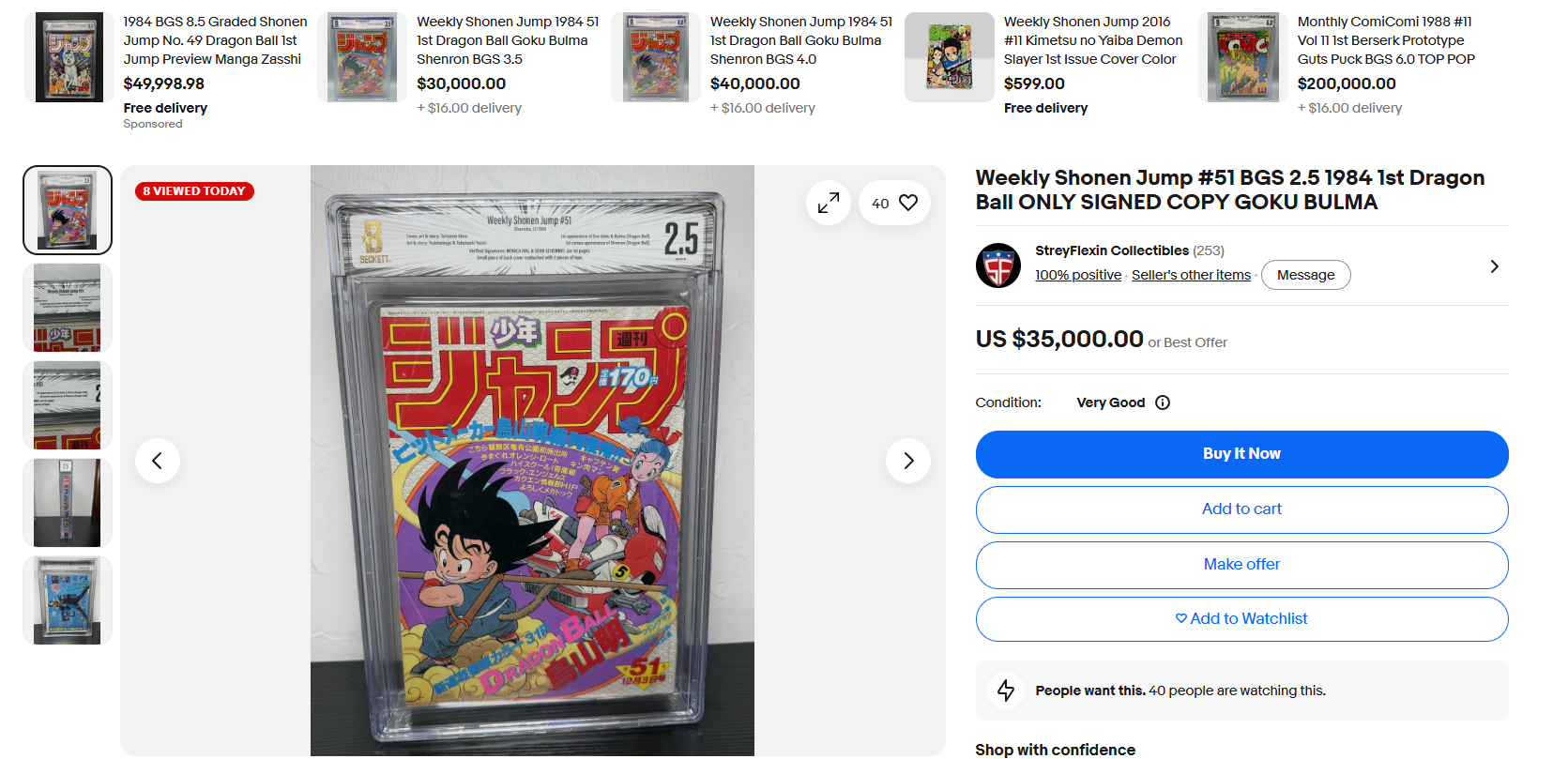
Logan Paul’s post triggered an “arms race” among global resellers, who began acquiring copies of Weekly Shonen Jump and collected volumes of major series for resale purposes, consolidating a market of aggressive collectors and manga scalpers. For those unfamiliar with the term, aggressive collectors buy historical products to resell them for over 1,000% of their actual value, while scalpers are individuals who buy large volumes of products to generate artificial scarcity and quickly resell them at substantially inflated prices.
Scalping in this niche operates under the logic of artificial scarcity: acquiring as many available copies as possible, not for the purpose of preservation, but to deplete the market and resell them for exorbitant amounts. Manga is treated practically like a cryptocurrency, similar to NFTs, stripped of its cultural and historical value in favor of purely financial gain. Manga readers and traditional collectors end up being pushed out of the ecosystem, replaced by crypto investors who do not even know the work of Akira Toriyama, Masashi Kishimoto, or Eiichiro Oda.
These individuals saw a quick and easy financial return opportunity in this emerging market. Consequently, they began buying up various lower-valued historical magazines (between $50 and $2,500) to resell them for amounts exceeding one or two thousand dollars, making many of the items that collectors used to acquire inaccessible. Upon noticing the formation of this speculative bubble, some traditional collectors also took the opportunity to sell off their collections.
Counterfeit editions and products also began to surface on the internet, including alleged sketches, fake autographs, and character designs never actually produced by Akira Toriyama. Scammers emerged with the goal of deceiving this new wave of buyers who are unfamiliar with the reality of the manga market, further aggravating the situation.
THE CURRENT STATE: SCALPERS IN JUNE 2026
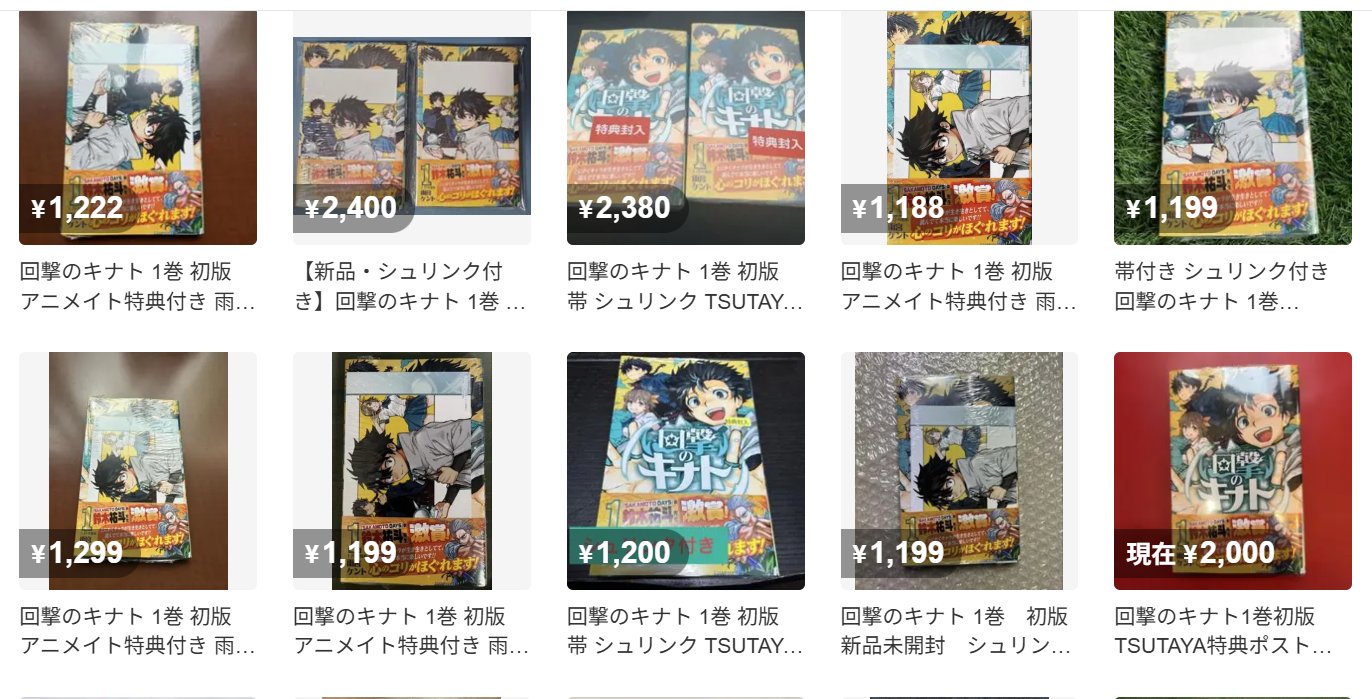
It is likely that this entire situation constitutes a speculative bubble, similar to that of NFTs, which will eventually burst; the central question is how long this collapse will take to occur. Currently, the scenario continues to worsen: not only are historical volumes being targeted by scalpers, but recent releases are too, as occurred with the latest volume of One Piece and the debut issues of the new Weekly Shonen Jump series: Under Doctor and Kinato’s Magic.
Scalpers acquired these volumes en masse, leading to them selling out within a few days and preventing series enthusiasts or curious readers from purchasing the collected volumes (tankobon), which are now only available through resellers who double or triple the cover price. While the impact was previously concentrated on historical volumes, currently even the Japanese public faces difficulties acquiring new releases. Even canceled works, such as Gonron Egg, can be found on resale websites.
In addition to generating distorted sales data—as in the case of Kinato’s Magic (a work at risk of cancellation) which ranked on the Shoseki Chart with a sales volume close to that of Shinobigoto (a modestly successful title in Weekly Shonen Jump)—the practice causes great dissatisfaction among the consuming public, worsening the crisis in the physical manga segment, which is already facing a continuous decline in consumption among young people. However, the most affected work is without a doubt Under Doctor, with scalpers allegedly purchasing over a thousand copies.
The publisher, obviously, still has the magazine voting system and survey mechanisms to gauge a work’s actual popularity; however, that is the least of the problems. The real problem lies in the fact that this strategy distorts the meaning of manga and directly attacks an ecosystem that many depend on.
Manga is a popular artistic expression, conceived to be economically accessible. Financializing this art not only constitutes a contradiction but actively assails the physical market, which is desperately trying to survive in the face of digital modernity. The commercialization of art affects not only readers but an entire ecosystem structured around price accessibility and the valuation of artistic work.
Bookstores might initially even celebrate selling out their stock, but the actual consumers have not been served. They are being forced to migrate to digital versions—and some may never return to physical formats if this problem persists for more months. The damage to bookstores and to all the jobs dependent on the manga print chain (production, logistics, sales, and the used market) could be severe if this bubble does not burst soon and if scalpers do not abandon this aggressive practice.
Scalpers will not destroy the physical market; however, they are generating an impact that transcends a mere price increase of an issue, affecting the work and income of various professionals. Therefore, if the scenario persists in the coming months, it becomes necessary for publishers to adopt stricter purchase control mechanisms, such as establishing a limit on copies per customer, following the example of what was done when Kagurabachi faced shortages in 2024.
Currently, it is global collectors and the Japanese public who are suffering from the supposed market manipulation initiated by Logan Paul and his allies. Should this practice prove effectively profitable for the scalpers and investors who commercialized manga, it will inevitably expand to other countries, reaching casual European, American, and Latin American readers, further worsening the current outlook.